Does the Government Support the Arts Does the Government Support Artists
Download:
 Arts Funding Snapshot: GIA's Annual Research on Support for Arts and Culture (2.8Kb)
Public funding for the arts in the U.s.a. comes from federal, state, and local governments. Congressional allocations to the National Endowment for the Arts (NEA), legislative appropriations to land arts agencies, and local government funds going to local arts agencies provide useful indicators of public support for the arts and culture. Together, these agencies and organizations distribute grants and services to artists and cultural organizations across the nation.
2019 Funding Levels
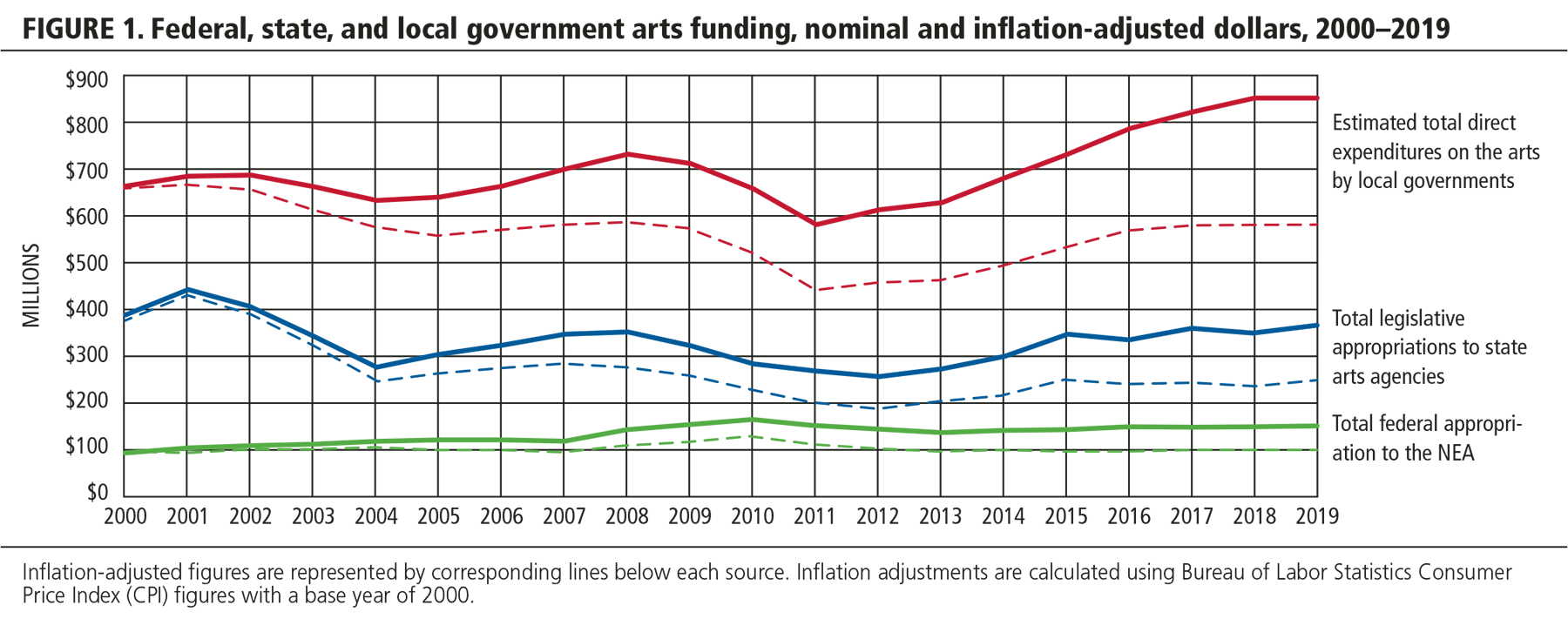
In Fiscal Year (FY) 2019, federal, state, and local public funding for the arts totaled $1.39 billion, for a full per capita investment of $iv.19. Comprising this total were:
- $155 one thousand thousand in appropriations to the NEA, an increase of 1.4% from FY2018.
- $370.5 million in legislative appropriations to country and jurisdictional arts agencies, an increment of three.6% from FY2018.
- $860.0 one thousand thousand in funds allocated by municipal and county governments to local arts agencies,1 which remained flat from FY2018.
Trends Over Time
In nominal dollars (not adapted for inflation), public funding for the arts increased past almost 20% over the past twenty years. State and local funding patterns correlate with periods of economic growth and recession. State arts agency amass appropriations reached a high point in 2001, while local funding reported a historical high bespeak last yr. Federal funding for the NEA has displayed incremental growth after sustaining cuts during the concluding recession.
Despite these nominal dollar increases, public funding for the arts has not kept pace with inflation. When adjusting for aggrandizement, total public funding decreased by xviii% over the past 20 years. In constant dollar terms, land arts agency appropriations decreased by 35%, local funding contracted by 12%, and federal funds have increased by ix%.
Serving a Growing Population
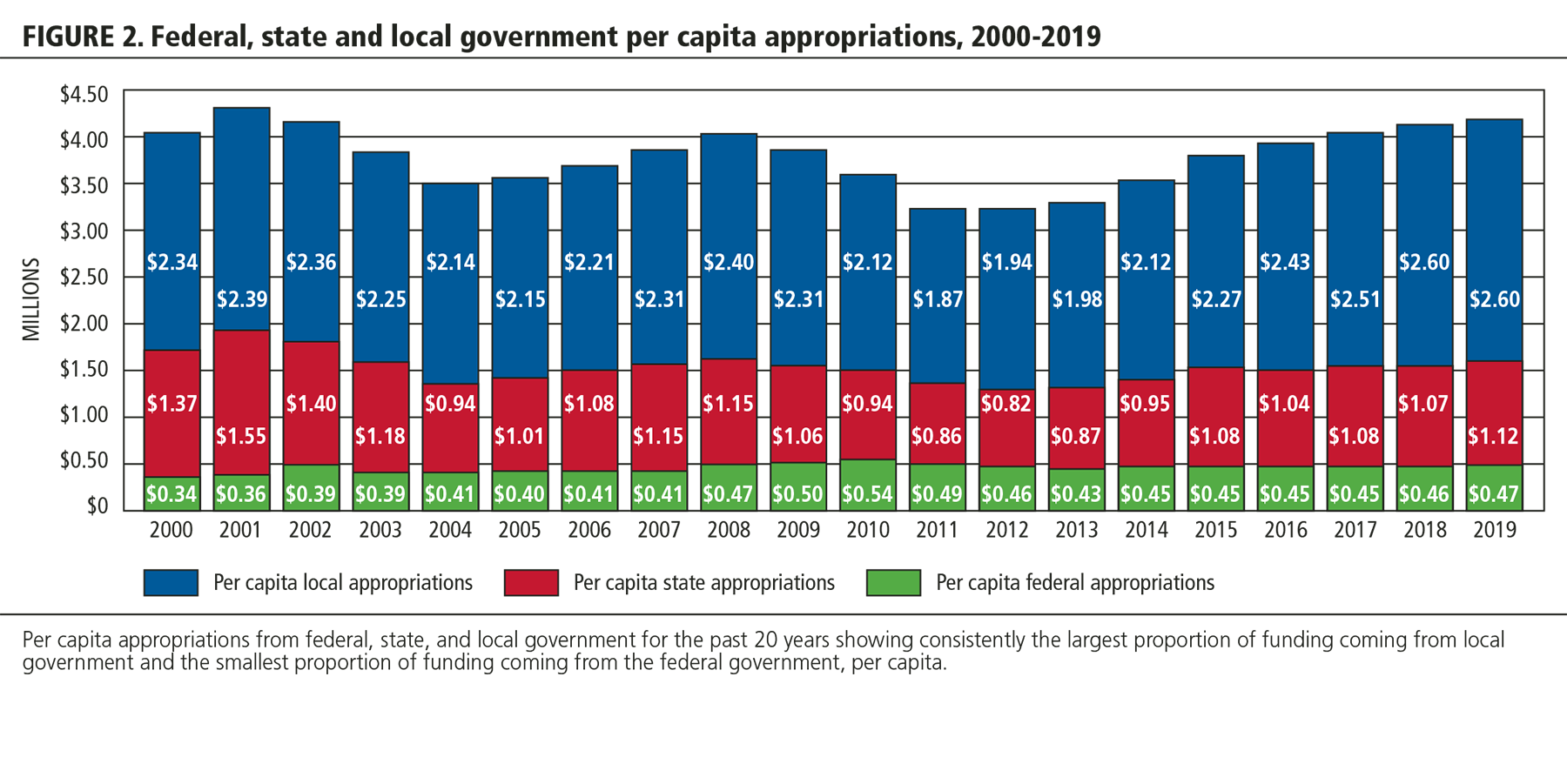
Measuring public funding relative to total population provides an important yardstick, considering that these funds originate from all taxpayers and are meant to benefit all residents. As populations grow, public arts agencies demand to serve more than people. Combined, federal, state, and local arts funding yielded a per capita investment of $4.19 in 2019. Federal, state, and local funding contribute $0.47, $1.12, and $2.threescore respectively. Combined per capita appropriations accept been increasing since 2012, merely are still below nominal 2001 levels. When taking inflation into consideration, total per capita cribbing equaled $2.87 in 2019. This analysis shows that the value of the dollar, combined with a growing population, increases the strain on public arts funding.
Looking Alee
Most states are experiencing an increase in total appropriations for the arts. Based on preliminary estimates for the year ahead, land arts funding is projected to achieve its highest level in the last twenty years in FY2020. However, appropriations to state arts agencies are constantly in flux, and mid-yr changes are probable to occur.2 Besides, not every state has seen this magnitude of increase. Seventeen states will probable experience flat or decreased funding for the arts in FY2020. Additionally, xx-eight states are still expected to invest less than $1.00 per capita for the arts.3
Congress has withal to pass a federal budget for FY2020 as of this writing. For the third year in a row, the President recommended a complete elimination of the NEA for next year. Notwithstanding, the NEA continues to receive broad back up in Congress from elected officials across the political spectrum, and both chambers have recommended increases for the bureau for FY2020. Until Congress enacts the spending bundle for the Department of the Interior — the upkeep bill in which the NEA is placed — standing resolutions have kept funding for the agency at FY2019 levels.
The outlook for local arts funding is harder to project. Although local arts funding is riding at an all-time high, its growth has stalled in contempo years, which mirrors the bleak budget conditions reported by many cities and counties. Overall, cities' revenue growth slowed down in 2018, and virtually two thirds of big cities are projecting recessions as early on every bit next yr.four Given this context, it will be important to monitor whether local spending on the arts may feel slower growth, if not outright declines, over the next few years.
Implications for Grantmaking
Equally seen currently at the local level, appropriated funds to the arts and culture at all levels of government ebb and menstruation equally fiscal conditions shift. Grantmaking is directly affected past the fluctuation of appropriations. By extension, organizations and individuals who receive grants and other forms of support from government agencies are indirectly affected by revenue growth and fiscal stability — or the reverse.
Straight federal grants from the NEA totaled two,239 and $59.three one thousand thousand in FY2018. Another $50.vii meg from the NEA, or about xl% of the Endowment's appropriated budget, was awarded to state and regional agencies for further grantmaking and related services. State arts agencies, using a combination of land and federal funds, awarded 23,118 grants and $315.i meg in award dollars in FY2018.
Local governments spend the about dollars on arts and civilisation when compared to states and the NEA, just local arts agencies are less likely to focus their services on grantmaking. Co-ordinate to the 2018 local arts agency census from Americans for the Arts, 59% of local arts agencies operate straight grantmaking programs.5 Larger percentages of local arts agencies back up straight culture programming (85%) and manage cultural facilities (63%). 53% of local arts agencies as well provide non-grant contracts to individual artists, while one 3rd provide non-grant contracts to organizations.
Grantmaking Across Sectors
The diverse roles of public and private grantmaking entities allow for a multiplicity of funding priorities and agendas. There is no exact alignment when comparison grantmaking information beyond public and private sectors. Additionally, local arts agencies practise not use standard data collection consistently across the county. However, using published data from state arts agencies, the NEA, and Candid's 2017 information on the one yard largest foundations, at that place are a handful of categories for which we tin approximate relative investments.
Foundations and land arts agencies make significant grant investments in operating support. Foundations spent approximately 26% of their arts and culture grant dollars on operating support in 2017. In terms of the percentage of dollars invested, both foundations and state arts agencies make the largest commitment to operational support. 37% of state arts bureau grant dollars and 24% of all country arts agency awards went to operational support in FY2018. The NEA'southward statute prohibits the agency from awarding operating back up grants.
The NEA invests over $50 million dollars in state arts agencies and regional arts organizations. These dollars are not operating support for individual arts organizations, but they aid enable state arts agencies and local arts agencies to make investments in operating back up past increasing the total dollars agencies have available for grants and services.
Outside of operating support, it is possible to compare a few other grant categories and activity types. Foundations, state arts agencies, and the NEA all make investments in museums and arts didactics. A cardinal dissimilarity between public and individual sectors is investment in capital structure and physical infrastructure. The NEA does not provide funding for uppercase construction, and relatively few state arts agencies make grants for facilities. Foundations deport the load for funding physical cultural infrastructure in the United States.
Some other challenging topic for grantmakers is investment in individual artists and fellowships.6 The NEA makes a few select investments in individual artists through National Heritage Fellows, Jazz Masters, and Literature Fellowships, but otherwise is statutorily restricted from awarding grant funds to individual artists. Many state arts agencies devote a portion of their grants to private artists.7 In FY2018, state arts agencies made ii,647 awards to individual artists. When compared to other types of applicants, awards to private artists were the second most frequent type of laurels fabricated past state arts agencies. Private foundations also fund individuals, merely comparing information is not bachelor.
Grantmaking by Accolade Size and Geographic Distribution
Like per capita calculations, analyzing award sizes and geographic distribution proves useful when assessing how public funds serve the entire population. The distribution of grants from publicly funded art agencies reflects the priority of geographic variety. In order to cover more basis with the amount of appropriations a public entity receives, many of these grants will be modest in size. To illustrate this, country arts agencies have a median award value of $5,000. Although the median award amount from the NEA is $20,000, 57% of all their awarded grants are less than $25,000 in size. In contrast, the one yard largest foundations laurels higher levels of grant dollars, the majority of which are higher up $25,000.
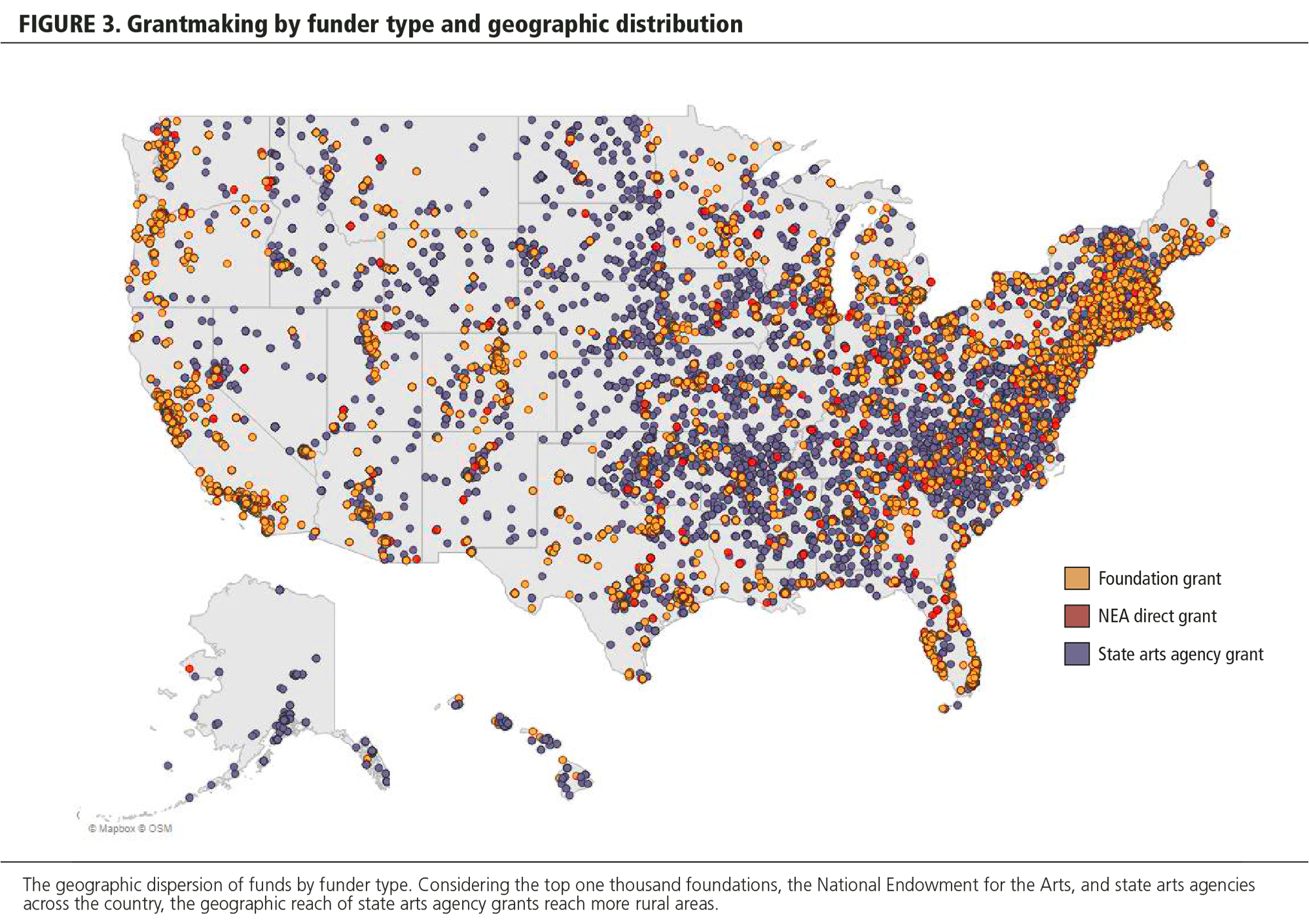
When taking a closer wait at the geographic dispersion of funds, variation in grant size allows for broader distribution of grants to all corners of the United states. More than than xc% of the state's landmass is considered rural, but only 18% of the population lives within those areas. Per the median grant sizes discussed to a higher place, smaller state arts bureau grants means a broader distribution of funds to smaller organizations. When mapping grants from the top 1 one thousand foundations, the NEA, and state arts agencies across the land, the geographic reach of land arts agency grants cover more rural areas.
State arts agencies award 21% of their grants — and 17% of grant dollars — to rural areas. At the federal level, over xi% of the NEA's grant-funded activities took place in non-metropolitan areas of the state in 2017.8 In contrast, a Us Department of Agriculture assay found that only 5.5% of large foundations' domestic grant dollars went to rural areas.ix Individual foundation dollars to arts and culture practise not achieve 65% of U.s. counties, whereas awards from the NEA reach 779 more counties than the top one thousand individual foundations.x
Regime support at the federal, state, and local levels is important for attaining access to arts and culture beyond a nation with iii.viii million square miles of land — though the cultural ecosystem requires both public and private back up to thrive.xi While the private sector provides the lion'due south share of support, public funds support different grantmaking patterns to run into the needs of their constituencies and public mandates.
Ryan Stubbs is senior director of research at the National Assembly of Country Arts Agencies.
Patricia Mullaney-Loss is a enquiry associate at the National Assembly of State Arts Agencies.
NOTES
- Americans for the Arts substantially inverse the methodology for collecting local arts bureau investments through the local arts bureau census in 2016. Annual estimates are used prior to 2011 and after 2016.
- National Association of State Budget Officers. Fiscal Survey of us. Autumn 2018. https://www.nasbo.org/mainsite/reports-data/financial-survey-of-states/fiscal-survey-archives
- National Associates of State Arts Agencies. FY2020 State Arts Bureau Legislative Appropriations Preview. 2019, https://nasaa-arts.org/nasaa_research/fy2020-state-arts-bureau-legislative-appropriations-preview
Tendency data on legislative arts funding in every state and jurisdiction can exist plant at https://nasaa-arts.org/nasaa_research/8306 - National League of Cities. City Fiscal Conditions 2019 Written report. 2019, https://world wide web.nlc.org/resource/city-fiscal-weather-2019-written report
- Americans for the Arts. Research Report: 2018 Profile of Local Arts Agencies; A Detailed Report about the Local Arts Bureau Field in 2018. 2018, https://www.americansforthearts.org/sites/default/files/2018_LocalArt sAgencyProfile_FullReport_REVISED.pdf
- "Support for Individual Artists." Grantmakers in the Arts, Spider web. https://www.giarts.org/support-private-artists
- National Assembly of State Arts Agencies. State Arts Agency Back up for Individual Artist Fact Sail. 2019, https://nasaa-arts.org/nasaa_research/indivartistgrantmakingfactsheet0316/
- National Endowment for the Arts. Appropriations Request For Fiscal Year 2020. 2020, https://www.arts.gov/sites/default/files/NEA-FY20-Appropriations-Asking.pdf
- Pender, John. United states. Department of Agriculture. Economic Research Service. Foundation Giving to Rural Areas in the United States Is Dispro-portionately Low. Bister Waves, 2015. Spider web. https://www.ers.usda.gov/amber-waves/2015/august/foundation-giving-to-rural-areas-in-the-united-states-is-disproportionately-low/
- Carter, Mary Anne. "The Importance of the National Endowment for the Arts." National Council on the Arts Public Meeting. eighteen Mar. 2019. https://www.arts.gov/national-council-on-the-arts/mary-anne-carter-remarks-march-2019
- Breaux, Pam. "Better Together: Public and Private Funding for the Arts." Shared Experiences Weblog. The Andrew W. Mellon Foundation, June 2017. Web. https://mellon.org/resources/shared-experiences-weblog/better-together-public-and-private-funding-arts/

Postar um comentário for "Does the Government Support the Arts Does the Government Support Artists"